
How to stop snoring: find out what works for you
Change one thing at a time, record the nights, and let the recordings decide.
The way to stop snoring is to find what makes your own snoring worse, and that is easiest to see on recordings. Snoring has different causes in different people, so a remedy that works for one person does nothing for another. Record a few ordinary nights, then change one thing at a time, such as sleeping on your side, skipping alcohol in the evening or using a nasal strip, and compare the nights. Within a couple of weeks you know what helps you.
This page is practical advice, not medical advice. If anyone has noticed pauses in your breathing, gasping or choking, read the section on seeing a doctor first.
Step 1: record a baseline
Before you change anything, record three or four normal nights. Put your phone on the nightstand, plugged in, about an arm’s length from your head, and record with Voice Memos or a sleep recording app. Setup details are in recording a whole night with Voice Memos.
Each morning, open the file in the free sleep recording analyzer. It marks moments louder than the room and flags those that repeat every 2 to 8 seconds, at the pace of breathing. Write down two numbers per night:
- Roughly how long the breath-paced runs last across the night.
- How loud the loudest moments are, in decibels over the room.
Those are your baseline. One night is noisy data; several nights show what is normal for you.
Step 2: change one thing at a time
Pick one change, keep it for three or four nights, and record each night the same way. If you change three things at once and the snoring drops, you will not know which one did it.
These are the changes most often suggested, roughly in order of cost and effort.
Sleep on your side
Many people snore more on their back, when the tongue and soft palate fall backwards. If your baseline shows long runs, try side sleeping. A pillow behind your back, or a body pillow, helps you stay there. If your snoring nearly disappears on your side, that tells you a lot.
Skip alcohol in the evening
Alcohol relaxes the muscles of the throat, and many people snore louder after drinking. Compare nights with a drink in the evening against nights without. The recordings often make the difference obvious.
Clear your nose
If your nose is blocked from a cold, allergies or dry air, you may breathe through your mouth and snore more. Things to try: nasal strips that hold the nostrils open, rinsing with saline, and treating hay fever. A pharmacist can suggest options. Nasal strips only help when the nose is the problem, so compare nights with and without them.
Raise the head of the bed
A slightly raised head and upper body helps some people. Lifting the head end of the bed a little works better than stacking pillows, which can bend the neck.
Look at the bigger habits
Snoring is often linked to body weight, smoking and being very tired. These take longer to change, so this is where weeks of recordings are useful rather than days.
Ask about a mouthpiece
Dentists and doctors can fit a mandibular advancement device, a mouthpiece that holds the lower jaw slightly forward during sleep. Ask a professional rather than buying one blindly, especially if you have jaw or tooth problems.
Step 3: compare the nights
After a few nights with a change, compare with your baseline. An example of what a log can look like:
| Nights | Breath-paced runs | Loudest moments |
|---|---|---|
| Baseline | long runs most of the night | about 20 dB over the room |
| Side sleeping | short runs, mostly early | about 12 dB over the room |
Your numbers will be different. What matters is the direction. Keep the setup identical so the comparison is fair: same phone, same spot, same distance from the bed.
If nothing changes after a few honest tries, that is useful too. It is a good reason to talk to a doctor or dentist instead of buying more gadgets.
When to see a doctor
Snoring on its own is common. See a doctor if it comes with pauses in breathing, gasping or choking, morning headaches, strong daytime sleepiness, or high blood pressure. These can be signs of obstructive sleep apnea, which needs a sleep study to diagnose. A recording can help you describe what happens at night, and snoring or sleep apnea explains what to listen for. To understand the decibel numbers, see how loud is snoring.
Let your phone keep the notes
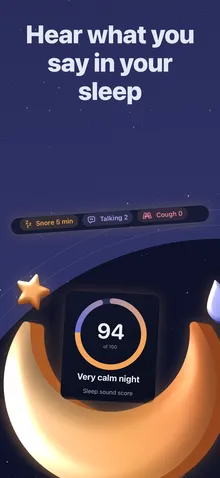
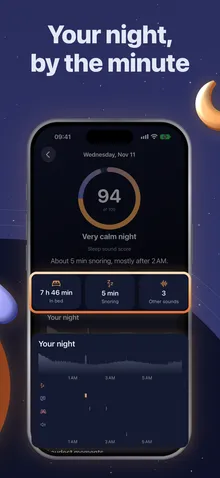
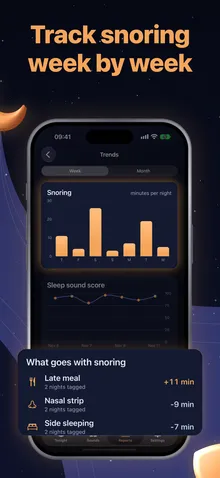
Nocturne for iPhone is made for this kind of experiment. It records from the nightstand, tells snoring from sleep talk and coughs with an on-device sound classifier, and gives each night a sleep sound score and a timeline. You can tag an evening with a late meal, a glass of wine or a nasal strip, and with Nocturne Pro the weekly view shows which nights went quieter. Recording is free every night, and nothing leaves your iPhone. Nocturne reports sounds, not health; it is not a medical device and does not treat snoring.
Every night, without scrubbing
Nocturne listens from the nightstand and keeps a clip of each moment.
- Listens for
- Snoring, sleep talk, coughs, loud noise
- Keeps
- A short clip around each moment
- Sleep talk
- Turned into text on your iPhone
- Each morning
- A score, a timeline by the minute, the moments
- Without Pro
- Every night recorded, the latest report, its three loudest clips
- Stays
- On your iPhone. No account, nothing uploaded

Before you record
What is the fastest way to stop snoring?
There is no single fastest fix, because snoring has different causes. Side sleeping and skipping alcohol before bed are the cheapest things to try first, and you can see within a few nights whether they help you.
Does sleeping on your side stop snoring?
For many people snoring is worse on the back, so side sleeping helps. Not everyone snores less on their side, which is why recording a few nights in each position is worth doing.
Do nasal strips work for snoring?
They can help when the snoring starts in a blocked or narrow nose. They do little for snoring that comes from the throat. Try them for a few nights and compare the recordings.
How do I know if a snoring remedy is working?
Record a few normal nights first, then a few nights with the change, with the phone in the same place. Compare how many minutes of snoring there were and how loud the peaks were.
When is snoring a reason to see a doctor?
If it comes with pauses in breathing, gasping or choking, morning headaches or strong daytime sleepiness. These can be signs of obstructive sleep apnea, which needs a medical assessment.
More on snoring and sleep talk
- Do I snore? Check last nightPick a night recording and hear every loud moment. Nothing is uploaded.
- Snoring or sleep talking?Both wake the room at 3 a.m. On a recording they sound nothing alike.
- Sleep talking recorderTwo ways to hear what you say at night, both on your iPhone.
- Why do people talk in their sleep?How common it is, what sets it off, and when it is worth a closer look.
- How loud is snoring?What the decibel figures mean, and how to measure your own snoring at home.
- When your partner's snoring keeps you awakeFixes for the snorer, fixes for you, and how to talk about it without a fight.
- Recording a whole night with Voice MemosSettings to check before bed, so the memo is still running in the morning.
- Coughing at night: record it, then count itA few nights of recording tell a doctor more than "I cough a lot at night".
- Snoring or sleep apnea?What to listen for on a recording, and what only a sleep study can tell you.
- How to tell if you snore, using your iPhoneapps.cihat.dev