
How loud is snoring?
What the decibel figures mean, and how to measure your own snoring at home.
Snoring is usually somewhere between about 40 and 60 decibels when measured near the sleeper, and above 60 dB is generally called loud or severe. One clinical sleep study classified snoring as mild at 40 to 50 dB, moderate at 50 to 60 dB and severe above 60 dB, while noting that the cut-offs are a convention rather than a law of nature. For comparison, quiet conversation is around 50 to 60 dB.
So yes: a heavy snorer can be about as loud as someone talking in the same room, all night.
Snoring next to everyday sounds
Approximate levels, as commonly given for typical distances:
| Sound | Approximate level |
|---|---|
| A quiet bedroom at night | 30 dB |
| A whisper | 30 dB |
| Mild snoring | 40 to 50 dB |
| Moderate snoring, a quiet office | 50 to 60 dB |
| Normal conversation | about 60 dB |
| Loud snoring | over 60 dB |
| A vacuum cleaner | about 70 dB |
Decibels are logarithmic: every 10 dB step sounds roughly twice as loud. Snoring at 60 dB sounds about twice as loud as at 50 dB.
What research has measured
- In one study of 162 people, snoring exceeded 45 dB(A) in two thirds of them, and 14 percent passed 53 dB(A).
- Studies of people with obstructive sleep apnea found louder snoring on average as apnea gets more severe: in one, average snoring rose from about 46 dB in people without significant apnea to about 60 dB in those with severe apnea.
These figures depend on how and where sound was measured. dB(A) weights the sound to match human hearing; other scales give higher numbers for the same snore. Distance matters too: every doubling of distance from the sleeper makes the snore quieter.
Why a phone reading is only a rough guide
A phone’s microphone is designed for speech, not measurement. It is not calibrated, and the phone may apply automatic gain or noise reduction. A sound meter app can still be useful if you keep the conditions the same:
- Same phone, same place, same distance from the bed each night.
- Compare nights, not absolute numbers.
- Look at peaks and how often they happen, not only the loudest second.
Measure your own snoring
- Put your phone on the nightstand, about an arm’s length from your head, plugged in, and record the night with Voice Memos.
- In the morning, load the file into the free sleep recording analyzer. It measures the background of the room, then marks each moment louder than that and how many decibels over the room it was.
- Look for moments that repeat every 2 to 8 seconds, the pace of breathing. Long runs of them are usually snoring.
- Record a few nights and compare. Did the runs get shorter after sleeping on your side, or on a night without alcohol?
The analyzer reports decibels over your room’s background, which makes nights comparable even when the absolute level is uncertain.
When to see a doctor
Loud snoring on its own is common. See a doctor if it comes with pauses in breathing, gasping or choking, morning headaches, or strong daytime sleepiness, which can be signs of obstructive sleep apnea. A recording can help you describe what happens at night, but only a sleep study can diagnose it.
Track it every night
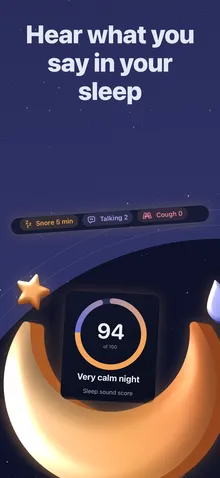
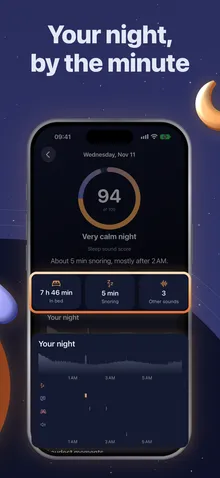
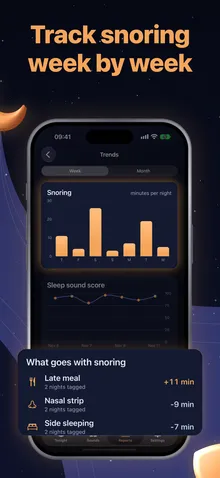
Nocturne for iPhone listens from the nightstand, tells snoring from sleep talk and coughs with a sound classifier, and gives you a score and a timeline each morning, with snoring tracked week by week. It keeps short clips, not the whole night, and nothing leaves your iPhone. Nocturne reports sounds, not health; it is not a medical device. If snoring in your home is someone else’s, see what to do when a partner’s snoring keeps you awake.
Every night, without scrubbing
Nocturne listens from the nightstand and keeps a clip of each moment.
- Listens for
- Snoring, sleep talk, coughs, loud noise
- Keeps
- A short clip around each moment
- Sleep talk
- Turned into text on your iPhone
- Each morning
- A score, a timeline by the minute, the moments
- Without Pro
- Every night recorded, the latest report, its three loudest clips
- Stays
- On your iPhone. No account, nothing uploaded

Before you record
How many decibels is snoring?
Studies usually measure snoring somewhere in the 40s to 60s dB, near the sleeper. One clinical study classed it as mild at 40 to 50 dB, moderate at 50 to 60 dB and severe above 60 dB.
What counts as loud snoring?
As a rough guide, snoring above about 60 dB near the sleeper is considered loud, comparable to normal conversation. It is loud enough to wake a light sleeper in the same room.
Is loud snoring a sign of sleep apnea?
Loudness alone does not diagnose anything, but studies have found louder snoring on average in people with more severe obstructive sleep apnea. Pauses in breathing, gasping or choking are stronger signs; see a doctor if you notice them.
Can a phone measure snoring decibels?
Roughly. Phone microphones are not calibrated and apply their own processing, so the reading is good for comparing nights on the same phone in the same place, not for an exact number.
How far away was the snoring measured?
Sound gets quieter with distance, so figures always depend on where the microphone was. Most studies measure close to the sleeper's head.
More on snoring and sleep talk
- Do I snore? Check last nightPick a night recording and hear every loud moment. Nothing is uploaded.
- Snoring or sleep talking?Both wake the room at 3 a.m. On a recording they sound nothing alike.
- Sleep talking recorderTwo ways to hear what you say at night, both on your iPhone.
- Why do people talk in their sleep?How common it is, what sets it off, and when it is worth a closer look.
- When your partner's snoring keeps you awakeFixes for the snorer, fixes for you, and how to talk about it without a fight.
- Recording a whole night with Voice MemosSettings to check before bed, so the memo is still running in the morning.
- Coughing at night: record it, then count itA few nights of recording tell a doctor more than "I cough a lot at night".
- How to stop snoring: find out what works for youChange one thing at a time, record the nights, and let the recordings decide.
- Snoring or sleep apnea?What to listen for on a recording, and what only a sleep study can tell you.
- How to tell if you snore, using your iPhoneapps.cihat.dev